
How to Fix Standing Water in Your Yard: A Delaware Drainage Guide
By the Union Park Landscaping crew · April 22, 2026 · 3 min read
To fix standing water in your yard, first identify the source: roof water needs buried downspouts ($800–$2,500), chronically wet zones need a French drain ($2,500–$8,000), and surface runoff needs regrading or a swale. Most soggy Delaware yards involve more than one of these, which is why guessing at a fix often fails. Here's how to diagnose yours like a contractor would.
Why Delaware yards hold water
New Castle County sits on dense clay soil that absorbs water slowly — sometimes fractions of an inch per hour. Add flat lots (Bear, Middletown), settled 60-year-old grading (Wilmington, Newark), or a house at the bottom of a slope (Pike Creek), and rain simply has nowhere to go. Nothing is "wrong" with your yard; it just needs the drainage the builder never installed.
Step 1: Watch where the water comes from
Go out during (or right after) a hard rain and answer three questions:
- Is it roof water? Follow each downspout. A single downspout can dump hundreds of gallons per storm right at your foundation. If puddles form near downspout exits, start there.
- Is it surface flow? Water arriving from a neighbor's yard or a slope needs to be intercepted and redirected.
- Is it just not draining? Puddles far from any water source mean compacted clay or a low spot with no outlet.
The fix must match the source. This is the step DIY solutions usually skip.
The fixes, cheapest first
Buried downspout extensions — $800–$2,500
Roof water gets piped underground to daylight at a lower grade, to a pop-up emitter, or into a dry well. Highest impact per dollar of any drainage fix, and often the whole solution for foundation-line sogginess and damp basements.
Regrading and swales — $1,500–$5,000
Where surface water flows the wrong way, we reshape the grade — a gentle swale steers water around the house instead of into it. On new-construction lots, note that the swales between houses are engineered drainage paths: they can be improved, but never blocked.
French drain — $2,500–$8,000
A gravel trench with perforated pipe that collects groundwater along its length and carries it to an outlet. The right fix for that strip of lawn that squishes for days after every storm. Cost depends on trench length, depth, and — the part people forget — whether there's a workable place for the water to go.
Dry creek bed — $2,000–$6,000
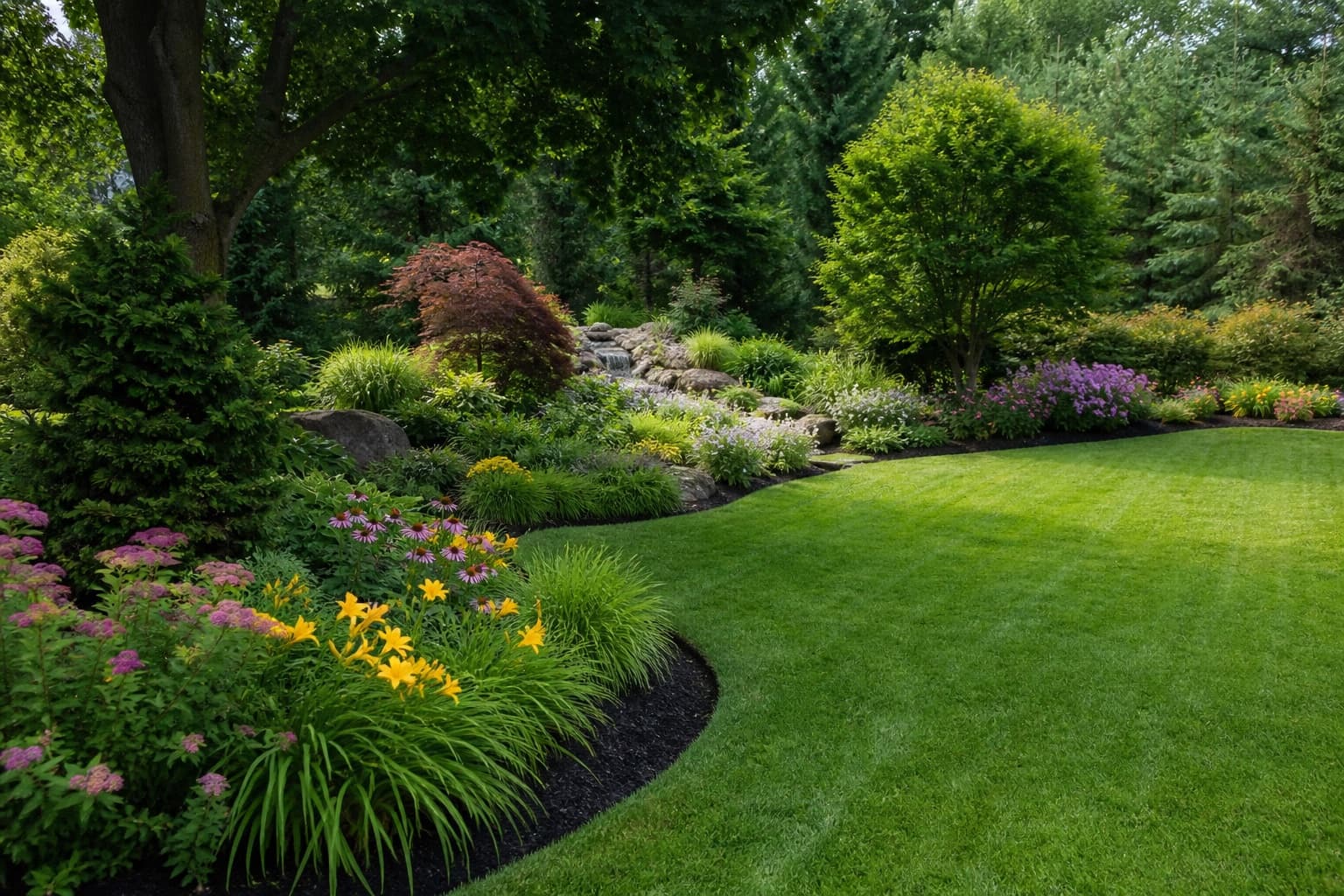
A stone-lined channel that handles heavy surface flow and looks intentional doing it. Great where a swale would just look like a ditch. Often paired with plantings that tolerate wet feet, like itea and inkberry.
What about a basement that gets damp?
Fix the outside first. Buried downspouts plus grading that pitches away from the house resolves a large share of damp-basement complaints for a fraction of the cost of interior waterproofing. If water still finds its way in after the yard is managed, then it's a waterproofing conversation — and we'll tell you honestly which case you're in.
Mistakes we get called to redo
- Splash blocks and 4-foot extensions on a serious roof-water problem — they move the puddle, not the water.
- French drains with no outlet, which are just buried bathtubs.
- Adding topsoil to a low spot without an outlet — now it's a higher wet spot.
- Corrugated pipe everywhere — it clogs with roots and silt; smooth PVC mains last decades longer.
Get it diagnosed free
We do free drainage assessments across New Castle County — ideally scheduled within a day or two of rain, so the evidence is still on the ground. Book a free assessment or read more about our drainage solutions.
Dealing with this in your own yard?
We give free written estimates across New Castle County, or preview changes first with our free AI yard designer.
Get a Free Estimate